
Na tej stronie
An e-bike battery is the most expensive single part of the bike, and the way you charge it quietly decides whether it lasts two years or five. The good news is that good charging is mostly about small habits, not special equipment. This guide walks through when to charge, how long it takes, what the lights mean, and the mistakes that quietly wear a pack out.

Quick answer: Charge when the pack is cool, stop around 80-90% for daily rides, and unplug when the light turns green.
Why charging habits matter so much
Lithium-ion packs age every time they move energy in or out. Heat speeds that aging up, and so do extreme states, like sitting at 0% or staying pinned at 100% for weeks. You cannot stop the clock, but you can slow it a lot. Riders who charge sensibly often get hundreds of extra cycles out of the same battery, which is money saved and range kept.
How often should you charge?
Daily commuters
Plug in after most rides, but stop around 80-90% unless you need the full range the next day. Partial charges are easier on the cells than running the pack down to empty and filling it all the way up every single time.
Weekend riders
If you ride two or three times a week, charge the night before and aim for a full pack only when you have a long ride planned. Between rides, keep it somewhere around half charge.
Long-term storage
If the bike will sit for a month or more, charge it to roughly 50%, remove the battery if you can, and store it indoors. Check it every few weeks and top it back up if it drifts low.
The right way to charge, step by step
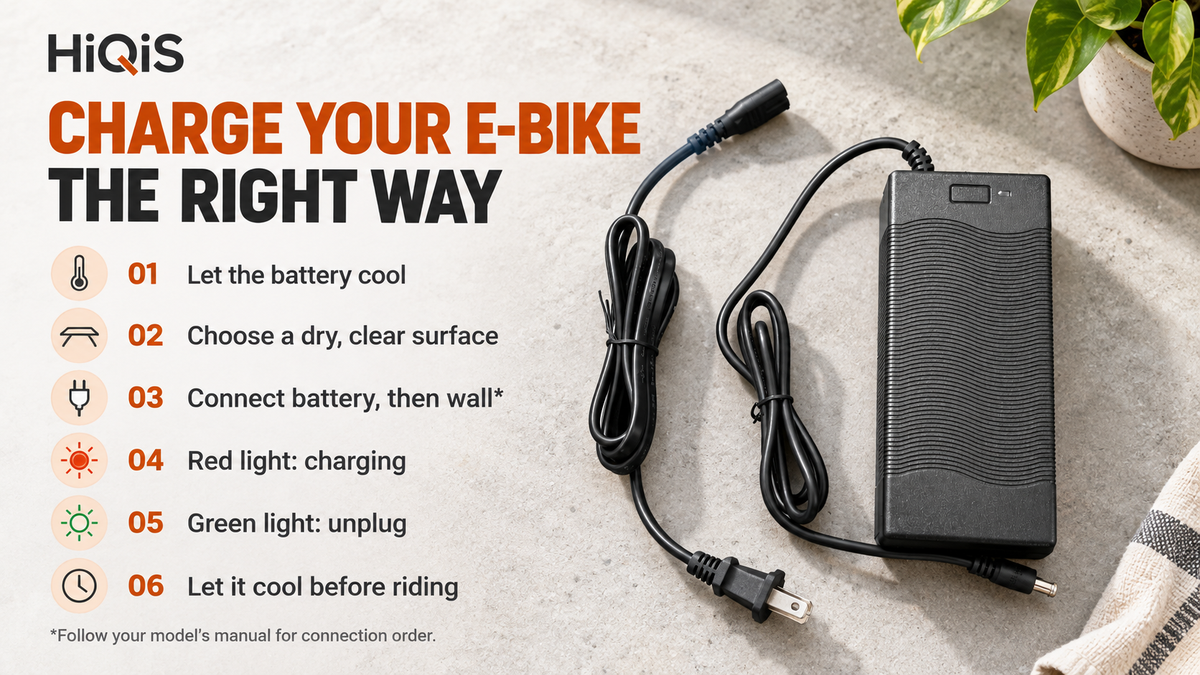
- Let the battery rest. After a ride, give it about 30 minutes to cool before plugging in.
- Pick a safe spot. A hard, flat, dry surface away from carpet, curtains, and direct sun.
- Connect the charger to the battery first, then to the wall. That order avoids a small spark at the plug.
- Watch the light. Red means charging, green means done.
- Unplug when it turns green. There is nothing to gain by leaving it connected for hours.
- Let it cool before the next ride if it feels warm to the touch.
How long does charging take?
Time depends on battery size and charger current. As a rough guide:
- 2A charger, 10-13Ah battery: about 5-7 hours.
- 3A charger, 10-13Ah battery: about 4-5 hours.
- 3A charger, 17-20Ah battery: about 6-7 hours.
A HiQiS 54.6V 2A charger is a good middle ground for most 48V packs: fast enough for daily use, gentle enough not to stress the cells.

Common charging mistakes
Charging a hot battery
Riding hard heats the pack. Plugging in immediately stacks heat on heat, which is exactly what shortens life. Wait for it to cool.
Using the wrong charger
The plug may fit while the voltage is wrong. A 48V pack needs a 54.6V charger, not a 48V one. Matching the voltage is not optional.
Leaving it plugged in for days
Once the light is green, the pack is full. Extra hours do not add range and keep the charger warm for no reason.
Charging to 100% out of habit
Full is fine when you need it. For everyday riding, 80-90% is easier on the battery and still plenty for most trips.
Charging in hot and cold weather
Summer
Charge indoors or in shade. A battery that sat in a hot car all afternoon should cool down before it goes on the charger.
Winter
Cold slows the chemistry and can permanently damage cells if you charge below freezing. Bring the pack inside, let it reach room temperature, then charge.
What the charger lights actually mean
Most e-bike chargers use two lights or one color-changing light. Red or orange means the pack is charging. Green means it has reached full voltage and dropped into a trickle or standby mode. Some chargers blink to show a fault, so check the manual if the pattern looks unusual.
Should you use a charge timer?
A simple plug-in timer is a cheap way to avoid overcharging and to charge at off-peak hours. Set it for the expected charge time plus a small buffer. It is especially useful if you plug in in the evening and forget.
Storing the charger
Keep the charger dry and off the floor. Do not coil the cable tightly around the brick, and do not leave it plugged into the wall when not in use. A charger that lives in a damp garage will fail sooner than one stored indoors.
FAQ
Can I leave my e-bike charging overnight?
It is not ideal. Most chargers stop at full, but a battery that stays warm and full for hours ages faster. Charge during the day or use a timer when you can.
Should I charge to 100% every time?
No. Charge to 100% when you need maximum range, and stop around 80-90% for everyday rides.
Can I use a different charger?
Only if the voltage matches and the connector fits. The safest choice is a charger built for your battery, like the HiQiS 54.6V 2A charger.
Why does my charger feel warm?
Some warmth is normal while charging. It should not be hot enough to hurt your hand. If it is, stop and check the charger and battery.
The bottom line
Charge cool, charge often, stop around 80-90% for daily use, and unplug when the light turns green. Those four habits do more for battery life than any gadget. When you need a replacement or a spare, match the voltage and get a charger built for your pack: the HiQiS 54.6V 2A charger is a safe, straightforward choice for HiQiS e-bikes.


